
Full fibre or leased line: which does your business actually need?
Both are fast, both are fibre, but they're built for very different jobs. Here's a no-nonsense guide to choosing between business full fibre and a leased line.
"Do we need a leased line?" It's one of the most common questions we hear, usually right after someone's video call has frozen mid-sentence.
Sometimes the answer is yes. Often, it's no, and a good business full fibre connection will do the job for a fraction of the price. Let's clear up the difference.
First, what's full fibre?
Full fibre (sometimes called FTTP, fibre to the premises) runs a fibre optic cable all the way to your building. Older "fibre" broadband only ran fibre to the green cabinet on the street, then used copper for the last stretch, which is where the slowdowns crept in.
Full fibre is now widely available. Ofcom's latest figures show it reaching around 82% of UK homes as of January 2026, and it's spreading fast. Business parks and high streets are steadily catching up too.
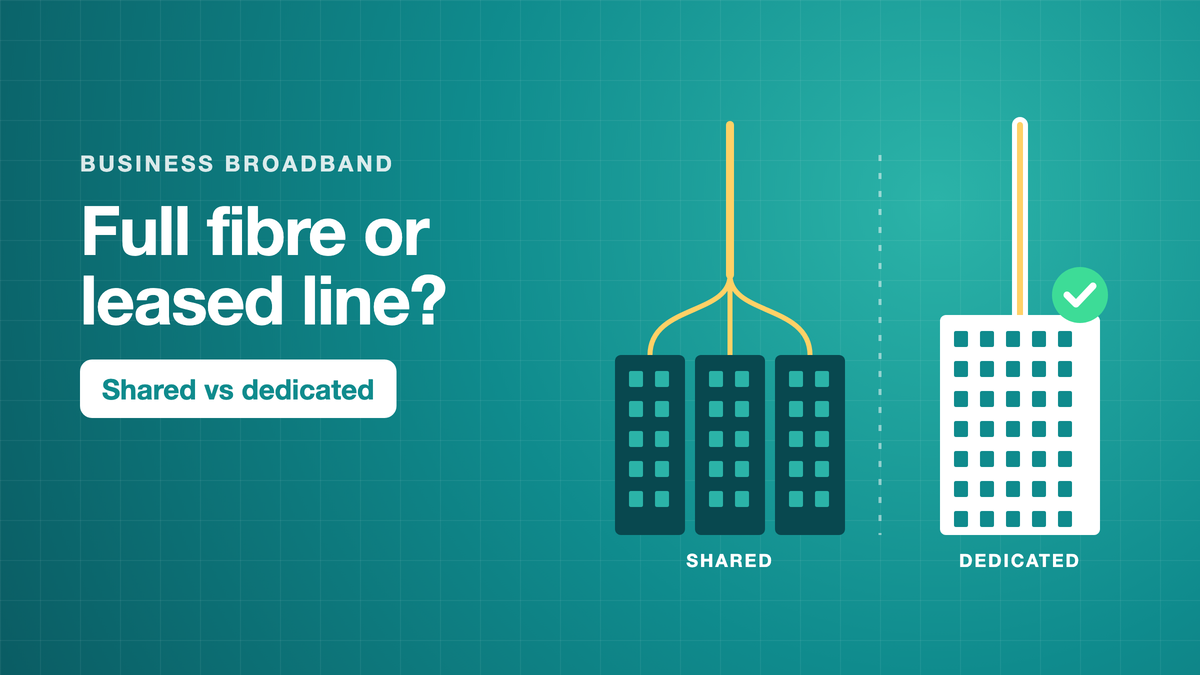
Full fibre is shared: the fibre from the street is split between a number of nearby premises. Day to day you'll barely notice, but it's the key difference from a leased line.
And a leased line?
A leased line is a private, dedicated connection from your premises to your provider's network. Nobody else uses it. That gives you a few things standard broadband can't promise:
- Guaranteed speed. If you pay for 500Mbps, you get 500Mbps, at 9am Monday or 4pm Friday.
- Equal upload and download. Leased lines are symmetrical, which matters if you send large files, back up to the cloud or run lots of video calls.
- Fast fix times. Leased lines come with a service level agreement (SLA), typically promising a fix within hours rather than days.
Side by side
- Speed: Full fibre is very fast, but "up to". A leased line is guaranteed.
- Upload: Full fibre uploads are good and improving. Leased lines match upload to download.
- Repairs: Business full fibre often comes with enhanced care. A leased line has a firm SLA with compensation if it's missed.
- Installation: Full fibre is often installed in a couple of weeks where it's available. Leased lines commonly take 30 to 90 working days, as there may be surveys, permissions and digging involved.
- Cost: Full fibre is far cheaper. A leased line is a bigger monthly commitment, usually on a longer contract.
So which one is right for you?
Full fibre is probably plenty if:
- You're a small or medium team doing email, cloud apps and video calls
- A short outage would be annoying, not a disaster
- You want great speeds without a big monthly bill
A leased line is worth a look if:
- You've got lots of staff all online at once
- Your business stops when the internet stops (think call centres, design studios, busy offices on cloud phones)
- You regularly upload large files or host services yourself
- You need a contractual promise on uptime and repair times
The middle ground
Many businesses get most of the benefits of a leased line for much less by pairing full fibre with a backup connection, such as 4G or 5G that kicks in automatically if the main line drops. Add a static IP address if you need remote access, CCTV or a VPN, and you've got a seriously robust setup.
How 365 can help
We supply business broadband from full fibre right up to dedicated leased lines, with routers, Wi-Fi and static IPs sorted for you. We'll check what's actually available at your address and recommend what fits, not just the priciest option.
Bundle it with your phones on our Combi plan for one team, one bill and no hidden fees.
Not sure which way to go? Book a free consultation and we'll give you a straight answer.
Stay busy. Stay connected.